Contents
2. The First Scams
Walk into almost any crypto community on Telegram, then or now, and one of the first things you meet is a warning. It is pinned to the top of the group, written in the slightly frantic capitalization of people who learned something the hard way: ADMINS WILL NEVER DM YOU FIRST. Sometimes it is gentler — Beware of scammers. We will never message you privately, and we will never ask for your seed phrase — but the thing underneath is always the same, and it is a confession. The community is telling you, on the way in, that it cannot protect you. It cannot tell you which of the accounts in the room is the real administrator and which is an impostor wearing the same name and the same photograph, so it has stopped trying to. It has posted a sign instead. The sign is the whole of the last chapter compressed into a pinned message: the room does not know who is in it, and it knows that it does not know.
That sign is where the subject of this book actually starts to bite. Not with the first spam — that is older than Telegram by thirty-five years and older than the web itself — but with the first moment the old, nearly free nuisance of spam showed up in a room that had real value lying around in it. On Telegram that moment came early, and it came hard, and to see why, you have to see what spam was before it found its way there.
Spam is older than the room it now haunts
Spam did not begin on a chat platform, and it did not begin with crime. It began on May 3, 1978, when a marketing manager at Digital Equipment Corporation named Gary Thuerk sent a message to roughly four hundred of the ARPANET's twenty-six hundred or so users — every West Coast address he and a colleague could pull from the printed directory — inviting them to demonstrations of DEC's new DECSYSTEM-20 computers. It was typed in upper case, the addressing was so clumsy that recipients' names spilled into the body, and nobody had asked for it. It is generally counted as the first mass unsolicited commercial message ever sent on a computer network: the first spam, sent before there was a word for it.
The reaction was immediate and hostile. Recipients complained; the network's administrators, who ran the ARPANET as a government research project and not an advertising channel, were furious; and one of them extracted from Thuerk a promise never to do it again. He didn't. He also claimed, for decades afterward, that the blast produced something like $13 million in sales — a self-reported figure nobody ever audited, but plausible in direction, because the message had reached almost exactly the few hundred people on earth with the budget and the appetite to buy a mainframe.
Sit with the shape of that, because the detail that matters is the one that never repeats. Everyone knew exactly who Gary Thuerk was. The ARPANET of 1978 was a small network of named researchers at known institutions; identity on it was real, scarce, and accountable. That is the only reason the social immune response worked. Thuerk was identified, scolded, and deterred — one man, one reputation, one promise that could be extracted and made to stick. The first spam in history was stopped by the one defense the open internet would never have again: a room small enough, and identities solid enough, that the community could answer who did this? and make the answer count. Every spammer after Thuerk learned the lesson without being taught it. Don't have a return address.
You can watch the defense fail the moment the network grows past the point of knowing its members. By the late 1980s a chain letter called MAKE.MONEY.FAST, signed by a probably fictional "Dave Rhodes," was circulating through bulletin boards — an old postal pyramid scheme transplanted onto a medium that made copying free, wrapped in fabricated testimony of debts erased and fortunes made. Nobody has ever identified Dave Rhodes, which is the point: the most-forwarded name on the early internet belonged to no accountable person at all. Then, on April 12, 1994, two immigration lawyers named Laurence Canter and Martha Siegel used a small script to post an advertisement — "Green Card Lottery — Final One?" — into more than five thousand Usenet newsgroups, a fresh copy in each, so it confronted every reader in every room they entered. The fury was volcanic; complaints crashed their provider's servers for days. And it cost them nothing. They did not apologize — they called the very idea of a Usenet community ludicrous — claimed a hundred thousand dollars in new business, founded a company to sell the technique, and wrote a book about it. Sixteen years after Thuerk, the same immune response fired at a hundred times the intensity and stopped nothing, because the network had outgrown its ability to know who anyone was. The only consequence that ever bit came from outside the network entirely: in 1997 the Tennessee bar disbarred Canter, in part for the spamming — the bar being one of the last institutions in the story where identity is persistent, costly to acquire, and impossible to throw away. Where reputation could attach, there was punishment. On the network, where it couldn't, there was only volume.
The word itself came from comedy, and it named the right thing. In a 1970 Monty Python sketch a café menu offers nothing without canned SPAM in it while a chorus of Vikings drowns out all conversation by chanting the word over and over; users of the early text-world games and bulletin boards borrowed the joke, and to "spam" became to flood a screen with repetition until nobody else could speak. Notice what the culture found remarkable enough to name. Not fraud, not deception, not even advertising — repetition at volume, the drowning-out of human conversation by tireless mechanical noise. That instinct was exactly right, and it takes the rest of this book to honor it. The deep problem was never what the messages said. It was that one actor could out-shout an entire room at no cost, and the room had no way to make him stop.
Why Telegram never got the innocent years
Hold that history next to Telegram and the misfit is obvious, and instructive. Email and Usenet spent decades dominated by spam as pure nuisance before crypto arrived — years of counterfeit watches and herbal supplements and stranded princes, a numbers game played for small change, in which the worst a typical attack cost you was a few seconds of annoyance and a scrolled-away conversation. There was a genuinely dangerous edge to it, and it is worth naming so the contrast lands honestly: phishing and banking trojans like Zeus were quietly draining real bank accounts in exactly these years. But even that predation lived in the inbox and the browser rather than in the open community, and it reached for money sitting inside a banking system engineered to reverse theft — chargebacks, fraud departments, account freezes, and a cash-out that had to run through money mules who were themselves a chokepoint where the theft could be traced and undone. The stakes inside the open room were low enough that a leaky defense — delete the message, ban the account, move on — was the rational answer, and the deeper question of who is this account, really? could be deferred for twenty years, because it genuinely did not matter who it was. It mattered only what they did, and what they did was easy to see and, even when it reached real money, usually possible to undo.
Telegram never got those innocent years. It launched in 2013 and, within a few years, became the operational home of the cryptocurrency world, and a crypto community is an open room with transferable, irreversible, anonymous crypto sitting in everyone's pocket. So the nuisance and the predation that the old internet experienced as two separate eras, decades apart, arrived on Telegram telescoped into each other — very nearly at once. The first wave of junk to hit a Telegram crypto group was still recognizably spam: bulk, low-effort, scripted, impersonal. But behind a meaningful share of it, from very early, was a hook running back to someone's wallet. The flyer under the windshield wiper and the hand reaching for your savings showed up in the same room, in the same week, sometimes in the same message.
This is the place to be precise about two words this book keeps apart. By spam I mean unsolicited bulk messaging whose entire economic model is volume against indifference: the sender does not need you specifically, only a tiny fraction of a very large number of people, and since the marginal message is free, any conversion rate above zero is a business. You are not a target; you are a denominator. By scam I mean what spam becomes when a hook goes behind the bait and the goal shifts from get a stranger to click a little more often than the next one to get this specific person to part with something real. On the old internet those two were separated by twenty years. On Telegram they were separated by almost nothing — which is why a chapter about the platform's first spam is unavoidably also a chapter about its first scams.
One caution before the catalog: the eras of this book are economic conditions, not calendar dates. They overlap, community by community, depending on when the crypto showed up. A hobbyist group could still be living in the pure-nuisance era while the crypto channel beside it was already deep into predation. So when an example here looks more advanced than "first" suggests, that is not an anachronism. It is the telescoping — the same weather arriving in different rooms at different times, and arriving in Telegram's crypto rooms almost all at once.
The impersonator
Return to that pinned warning, because the scam it warns against is the one that defines Telegram's first wave and previews almost everything to come. The move is impersonation, and the platform could not have made it easier. A Telegram account's display name and photograph are free to choose and free to change, as often as you like; an account created a minute ago can wear the exact name and avatar of a project's lead administrator by the time it finishes loading. So a scammer would do precisely that — clone the admin, down to the username, where the platform's near-misses (a swapped letter, an added underscore, a capital I standing in for a lowercase l) let a fake handle pass for the real one at a glance — and then work the room the open platform handed him. He would watch the public group for anyone asking a question and DM them privately as the "admin," helpful and fast: Hey, saw your message, happy to help — just verify your wallet here. Or he would skip the room entirely and message the whole membership at once, because the membership was for sale, as we are about to see.
The richest version layered a second classic on top of the impersonation: the giveaway, the double-your-money. Send 0.5 ETH to this address to verify, the message said, and receive 1 ETH back — a celebration of the launch, a thank-you to the community, a limited-time event — often in the borrowed name of someone famous enough to make it plausible, an exchange, a founder, an Elon Musk or a Vitalik Buterin whose photo and name cost nothing to wear. It is MAKE.MONEY.FAST with a wallet address instead of a mailing list: the same fabricated urgency and fabricated generosity, run in a room where the payment was instant, irreversible, and untraceable. Dave Rhodes at least had to wait for the mail.
And notice what the community's only available defense was: the pinned sign. Unable to tell the real admin from the fake — because nothing distinguished them but a history the platform did not surface and a name the platform let anyone copy — the room fell back on a blanket rule. We will never DM you first. It is a confession dressed as advice, and it is the purest possible proof of the thesis: when you cannot answer who is this?, the only thing left is to tell everyone to trust no one. That is not a defense. It is a community living with a disease it cannot cure, posting a warning where a cure should be.
The mass-add bot
If impersonation was the sharp edge, the broad base of the first wave was the mass-add bot. An open platform that lets anyone create a group and anyone join one has to decide how people get added, and the growth-friendly choice — the one Telegram made — was to let members add other members, and to let bots do programmatically what a member could do by hand. So a spammer would script a fleet of accounts to drag as many users as the rate limits allowed into a group he controlled: a fake giveaway, a pump channel, an empty shell whose only purpose was to look populated. You would unlock your phone to find you had been added to "🚀 CRYPTO SIGNALS VIP 🚀" alongside nine hundred strangers, none of whom had asked to be there either.
It worked because a number is a cheap proxy for credibility. A group with ten thousand members looks like a place where something real is happening, and the first thing the scammer learned to manufacture was the number. It did not matter that the ten thousand had been dragged in against their will and would never read a word; the headcount was the product, and it made the next genuine visitor likelier to stay. This is the first appearance of a theme that will dominate the book's final act — the fabrication of social proof, the same trick Dave Rhodes ran with invented testimonials, now run with invented bodies. The mass-add bot can make the fake members present but it cannot make them talk; in the chapters on synthetic communities we will watch attackers solve exactly that, fabricating members who answer questions and argue convincingly that the scam is real. The goal is identical and the lineage is direct, and both rest on the same fact: the platform cannot tell ten thousand real members from ten thousand fabricated ones, because an account is an account, and one person can be behind one of them or all of them. This is the Sybil problem from Chapter 1, making its first quiet appearance in the wild — the ambition turned all the way down, many fake identities deployed not yet to defraud but merely to fill seats. The ambition turns up later. The mechanism never changes.
Scraping the room
The mass-add bot pushed members into a room — real ones dragged in against their will, fake ones spun up to fill seats; member scraping pulled real ones out. Telegram, by design and by the openness of the API that powered its clients, exposed its membership — a public group's roster was visible, or at least walkable, account by account. A scraper would crawl a target group, a large trading community or a popular regional chat, and harvest every username and ID into a database. Then the database became a targeting list, and an entire gray market grew up to service the trade: scraper-and-adder tools sold openly in Telegram's own channels, priced by the thousand, advertised with the headcounts they could move.
The harvested users were valuable for the simplest possible reason: they had already shown their interest by being where they were. People in a crypto-trading group are, by definition, interested in crypto trading; people in a city's marketplace group live in that city. A scraped list let the spammer aim — not at a person yet, but at a category, a pre-filtered audience the community had assembled for him and left the door to. Canter and Siegel had done exactly this at network scale, treating Usenet's own index of newsgroups as a directory of pre-sorted audiences; the Telegram scraper just did it with finer grain and better tooling. Scraping fed two moves downstream: the mass DM, hitting each harvested user with the same pitch, and the re-add, feeding the list into a mass-add bot to populate the next fake group — which could then be scraped in turn. The platform's own social graph became the raw material of the attack. And it is the moment the attacker first begins to care who you are — not as an individual yet, but as a node with attributes. In this era he used that knowledge bluntly. When the crypto fully arrives, he will use it like a scalpel.
Link and keyword spam
The workhorse of the wave, the thing that filled the most groups with the most garbage, was plain link spam: a message, or a flood of identical messages, carrying a URL and a few lines of bait — cheap pharmaceuticals, counterfeit goods, adult sites, follower-boosting services, and, increasingly, the crypto-flavored versions: a fake airdrop, a malicious "wallet connect" page, a too-generous presale. Mechanically there was nothing to it, which was the point; the barrier to entry was a keyboard, and the only craft involved lived in evasion, the cat-and-mouse with platform detection that the next chapter is about. The spam was dumb on purpose, because dumb scaled, for exactly the arithmetic Chapter 1 laid out: when the next ten thousand recipients are free, a terrible funnel is still a profitable funnel — right up until an attempt costs something, which is the pressure point the last part of this book exists to lean on. You don't have to catch the spam. You have to make the spam not pay.
Keyword spam was the same move optimized for discovery instead of reach. Telegram is searchable, so a scammer would stuff a group's name, description, or username with high-traffic terms — a trending token, a major project, a brand, the word support — so that a user searching for the real thing surfaced the fake instead. It is search-engine poisoning translated onto a chat platform, and it has aged terribly well, because when someone searches "wallet support" today the keyword-stuffed group that greets them is no longer selling watches. It is harvesting their seed phrase. The move was fully formed in the first wave. Only the consequences grew up.
I want to be honest about how most of this looked at the time, because a reader primed by headlines about billion-dollar fraud may overestimate the early menace. The overwhelming bulk of it was junk — the digital flyer under the windshield wiper — and you learned to tune it out. You learned that a bare link and a row of fire emojis was almost certainly garbage, and you scrolled past. The human eye got good at the pattern because the pattern was so consistent, and that consistency — the fact that early spam looked like spam — is the quiet protagonist of the whole defensive story, and the thing AI will eventually take away. But in this era the tell was reliable, and a reliable tell makes a threat tolerable. You can live with a predator you can always see coming.
The shock waves
Not all of the early flood was commercial, and not all of it could be survived by scrolling. There was a category whose purpose was not to sell you anything but to defile the room — to dump pornography, gore, shock imagery, or, in the worst case, child sexual abuse material into a community as fast as a script could post it. The motives were various and mostly ugly: a raid wrecking a target for sport or revenge, a lone actor with a grievance, commercial porn advertising through a firehose of previews, and, in the darkest corner, CSAM posted to traffic it or simply to inflict it — to force a horror into a room full of people who could not un-see it, and to put the group's operators in legal jeopardy for having hosted it for the seconds it took to delete.
I separate this from commercial spam deliberately, because it breaks the nuisance frame in one specific way. Most early spam cost you attention and cleanup. This cost trauma — and, with CSAM, genuine harm to genuine victims whose abuse was being circulated. It belongs in this catalog rather than the next one's for a structural reason, not a moral one: the fraud that defines the crypto era is extractive, built to transfer value from victim to attacker, while the shock wave was destructive for its own sake, closer to vandalism than to robbery. But it shaped defense more than any commercial spam did, which is why it cannot be left out. Link spam, platforms could afford to be lazy about; CSAM they could not, because the legal exposure was absolute and the moral exposure worse. The first defensive infrastructure that platforms took genuinely seriously grew up around this category — automated hashing of known illegal images, fast-path reporting, mandatory takedown pipelines, cooperation with law enforcement. It is where platforms first learned that some content cannot be tolerated at any volume. It is also where they learned a lesson that would mislead them for a decade: the belief that if you can find and delete the bad content fast enough, you have solved the problem. That is true for CSAM, where the content itself is the crime. It will fail catastrophically for fraud, where the content is innocent and the actor is the crime. The platforms do not know that yet.
Floods
The simplest weapon in the catalog, and the one the word was coined for, is the flood. Point a script at a room and make it post, fast and without stopping, until the room is unusable. The content barely matters — the same word a thousand times, a wall of emojis, random garbage — because the payload is not the message, it is the rate. A flood does not try to deceive anyone; it tries to drown them, exactly as the Vikings drowned the café. One determined account with a loop and a too-short sleep timer could push a conversation off the screen faster than anyone could read it, and a handful of coordinated accounts could take a busy community dark in seconds.
Floods expose an asymmetry worth naming, because it recurs in every era: the gap between production and consumption. A machine produces messages far faster than a human can read them, and nothing in an open platform's architecture corrects for that — one automated account out-shouts a hundred people not because it is smarter but because it never stops and never tires. Scaled up and made intelligent, this is the AI era's defining threat: thousands of tireless personas under one operator. The flood is that same asymmetry at its dumbest, pure rate with no intelligence behind it; the machines add the intelligence later, but the rate advantage was always there. Defenders answered floods the obvious way, with rate limits — if an account posts more than N messages in M seconds, throttle it — and it worked reasonably well, because nothing that posts forty times a second is a person. But the counter was just as obvious: slow down, spread out, use more accounts. One account flooding at forty messages a second gets caught; forty accounts posting once a second do not. The flood does not go away. It distributes — across exactly the cheap, disposable identities the open platform hands out for free.
Raids
The most social item in the catalog, and in some ways the most revealing, is the raid: a coordinated assault by a group of people working together to overwhelm and destroy a target community. The toolkit is everything already listed — floods, shock dumps, mass-joins — but deployed in concert by a mob instead of a lone script, often at a set time, sometimes branded with the raiders' name, designed to humiliate the target before its moderators could respond. Raid culture grew up in the corners of the internet where disruption was the entertainment, and the motive was almost never money. It was status, or grievance, or destructive fun.
Raids earn their place for two reasons. The first is that they pioneered coordination — the discovery that many attackers acting together overwhelm a defense that any one of them could not. A single flooder gets caught by the rate limiter; fifty flooders each staying under it do not, and together they do far more than fifty times the damage. The swarm — many cheap identities acting under one coordinating will — is exactly the structure the crypto era industrializes and the AI era automates. A pump-and-dump ring firing sub-second buys across a fleet of accounts is, structurally, a raid with a profit motive bolted on. Only the goal changed, from chaos to cash.
The second reason is subtler, and it is the through-line of the whole book. A raid is a Sybil attack staffed by real humans. The fifty accounts pouring into the room are, often enough, fifty actual people — and that matters enormously, because it is the case the eventual cure has the hardest time with. The argument this book builds toward is that the durable answer to open-community attacks is to make identity costly and reputation real, so that one operator cannot cheaply wear a thousand faces. That argument is devastating against the lone operator with a bot fleet. It is much weaker against fifty real people who each control one real, costly, reputable identity and have simply chosen, together, to misbehave. The raid is the early, low-stakes preview of the one residue the cure cannot fully eliminate — and its grown-up forms, the troll farm and the recruited click-worker and the borrowed real account, wait at the very end of the book. Keep raid culture in mind when we get there. It is the proof, planted early, that making identity costly raises the floor on bad behavior dramatically but never quite to infinity.
The baseline taxonomy
Step back from the individual moves and the shape of the whole comes clear. Strip away the specific content — the mainframes, the green cards, the watches, the fake airdrops — and only a few underlying capabilities are being exercised, and every one of them traces to the open platform's two structural gifts to attackers: free entry and free identity.
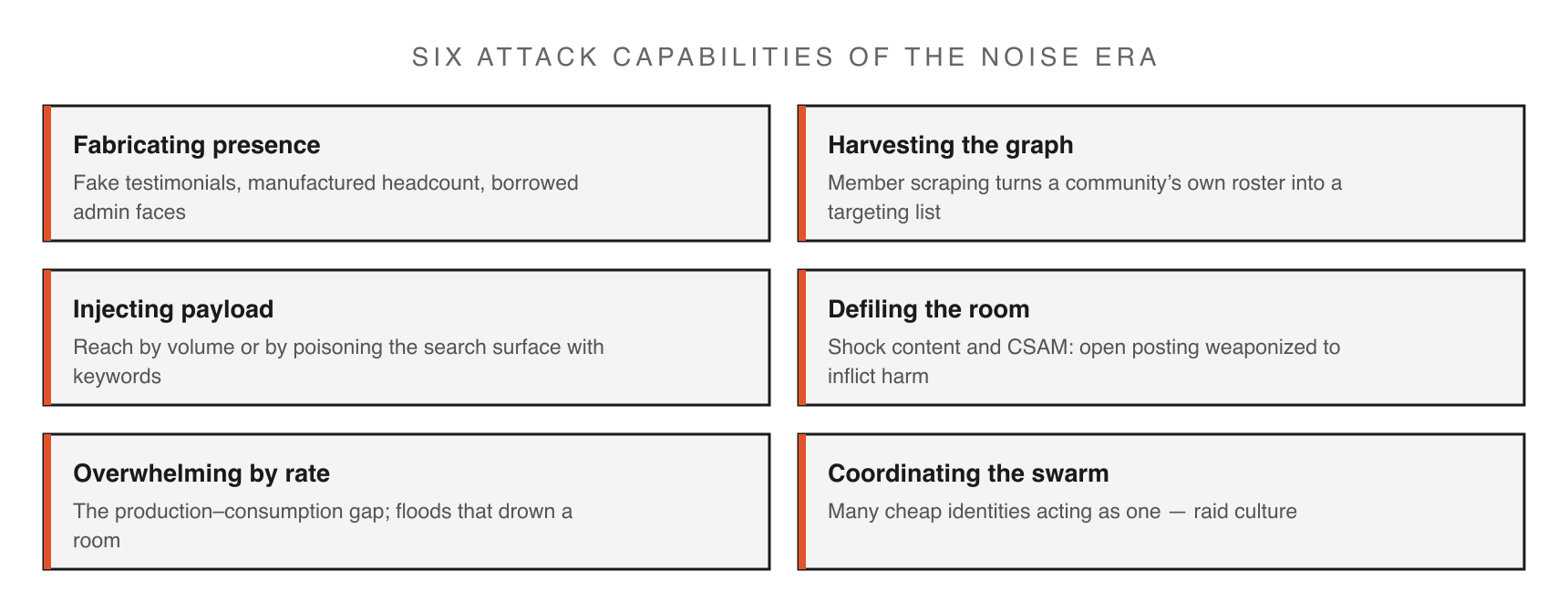
There is fabricating presence — Dave Rhodes's invented testimonials, the mass-add bot's manufactured headcount, the impersonator's borrowed face: trust conjured out of nothing. There is harvesting the graph — the member scraper, and before it the lawyers treating Usenet's index as a directory of audiences: the community's own structure turned into a targeting list. There is injecting payload — Thuerk's four hundred recipients, the green-card ad in five thousand rooms, the link and keyword spam in every channel: getting a message in front of eyes, by reach or by poisoning the search surface. There is defiling the room — the porn, gore, and CSAM waves: open posting weaponized to inflict harm rather than extract value. There is overwhelming by rate — the scripted flood, the original sense of the word: the production-consumption asymmetry used to deny a room to its own members. And there is coordinating the swarm — raid culture: many actors acting as one, against defenses built for individuals.
Six capabilities, every one resting on the same unanswered question. Fabricating presence requires that fake members and fake admins can't be told from real ones. Harvesting requires that the harvester is anonymous and disposable. Injecting at scale requires endless free accounts to inject from. Overwhelming by rate requires that throttling one account doesn't matter, because the attacker is forty accounts. Coordinating the swarm requires that the swarm is cheap to assemble. Each is an exploitation of the single fact that on an open network identity is free, disposable, and unverifiable — that nobody can do to the attacker what the ARPANET did to Gary Thuerk. Carry these six forward, because the central claim of this book is that the eras to come invent almost nothing new. They take these same six capabilities and do two things to them: they attach crypto, which converts every one from nuisance into predation and pays for the effort it takes to make them precise; and they attach machine intelligence, which removes the human bottleneck and lets one operator run all six at industrial scale, with personas indistinguishable from people. The impersonator becomes the deepfaked founder. The mass-add bot becomes the AI-populated synthetic community. The scraper becomes the targeting engine behind a personalized con. The link spam becomes the wallet-drainer funnel. The flood becomes the bot swarm. The raid becomes the coordinated pump ring. Nothing on the list is retired. Everything on it is upgraded.
Get Chapter 8 free
Subscribe and Chapter 8 opens for you too, once you reach the end of Part II.
One email to confirm, then an occasional note about the book. Unsubscribe any time.