Contents
7. The Attack Economy
Behind the catalog is a supply chain.
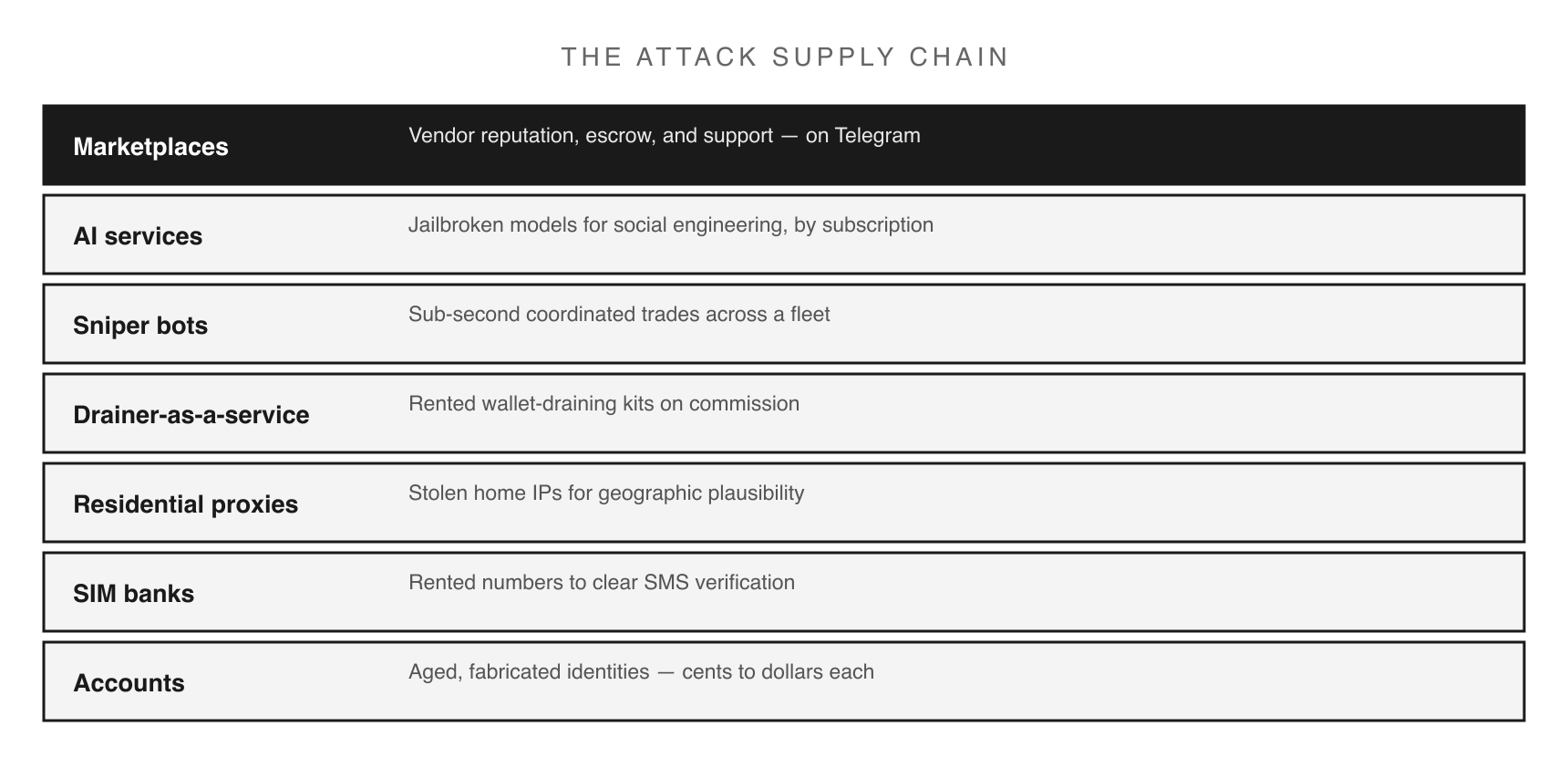
The two preceding chapters read like a menu: pig butchering here, pump-and-dump there, fake-VC outreach, trading-bot drains, drainer kits, malicious support bots. Read that way, each scam looks like a discrete creative act — some clever criminal sat down, dreamed up an angle, and executed it. That is the wrong mental model, and holding it is the single most common reason defenders lose. The angles are interchangeable. What persists underneath them is infrastructure, and the infrastructure is shared.
If you have ever shipped software, you already understand the shape of what follows. No serious product is built by one person doing everything from bare metal up. There is a hosting layer, an identity layer, a payments layer, a notifications layer, a CI pipeline, a set of third-party APIs you rent rather than build. You assemble. The economic logic of assembly — specialize, sell the specialty, let someone else integrate it — is so powerful that it reorganized the entire legitimate software industry into a stack of vendors. The same logic reorganized fraud. What we call "scams" are applications. They run on a stack. And the people who build the stack mostly never touch a victim.
This chapter is about that stack: the account farms and SIM banks at the bottom, the proxy networks that make the accounts plausible, the drainer-as-a-service platforms that turn a stolen signature into liquidated funds, the marketplaces where all of this is rented by the day, and the sniper bots that execute the final move in milliseconds. Then it is about the arithmetic — the cost to attack versus the payout — because the arithmetic is the only thing that explains why the flood never stops. And it ends by naming the one structural fact that every layer of this stack quietly depends on, the fact the rest of this book is built to resolve: the faces are free.
The bottom of the stack: accounts as a commodity
Start with the thing every attack consumes and discards: accounts.
An open community is, definitionally, a room you can walk into. On Telegram you join a group or a channel with a tap; you do not prove who you are, and the platform does not ask. That openness is the product — it is why people came, and we will keep returning to it as the original sin and the original virtue. But it means the unit of presence in the room is not a person. It is an account. And an account, unlike a person, can be manufactured.
The manufacturing is industrial. There is an entire trade in account registration, and it is segmented by quality the way any commodity market is segmented. At the cheap end you have freshly registered accounts, created in bulk, often algorithmically, with no posting history and no contacts. These are throwaways. They cost cents, sometimes fractions of a cent at volume, and they exist to be burned — to send one drive-by direct message, to pad a subscriber count, to post one link before the ban hammer falls. At the expensive end you have "aged" accounts: accounts registered months or years ago, warmed up with some activity, given a profile photo and a bio and a plausible join history, sometimes with real conversations seeded into them. Aged accounts on the open market sell for roughly $1 to $10 apiece depending on age, region, and history, and that price is the entire point. An aged account survives an automated filter that nukes a day-old one. The market is pricing exactly one thing: the probability that the account reads as a person.
Sit with that, because it is the thesis of the whole book in miniature. The account market is a market in fabricated identity. The price of an account is a function of how convincingly it impersonates a human with a past. Nobody in this trade is selling scams. They are selling the appearance of being someone.
The trade is also more vertically integrated than the casual buyer ever sees. The cheapest accounts are mass-registered in a single automated burst and shipped raw. The expensive ones go through a process that the underground frankly calls "warming" or "aging" — a deliberate cultivation pipeline that mirrors, almost line for line, the growth-hacking playbook a legitimate startup uses to make a new account look established. The accounts join popular public channels so their membership lists read as normal. They post innocuous messages on a believable cadence so the activity graph has texture. They accumulate a few contacts, a profile photo that survives reverse-image search, a bio in the target language. Some operations season accounts for months before they are ever sold, treating the inventory as an appreciating asset: an account that does nothing today is worth more next quarter precisely because it will have done nothing suspicious for a quarter. This is the part that should unsettle a defender, because it inverts the most basic heuristic in the moderation toolkit. The intuition that "older accounts with history are more trustworthy" is not a defense. It is a price signal the attackers read off the same chart you do, and then pay to satisfy.
This is not a Telegram peculiarity. The same commodity market exists for every open platform with self-serve accounts and value in the room. Aged and "phone-verified" account markets are a fixture of the abuse economies around X, Discord, WhatsApp, and the major email providers; the brand on the account changes, the trade does not. Telegram is simply where the per-account return is highest right now, because it is where the crypto and the people concentrated while the native identity stayed thin. Wherever open access, weak identity, and value in the room line up, an account farm grows to meet them.
Where do the accounts come from? Telegram, like most platforms, ties registration to a phone number. That is the speed bump. It is not a wall — it is a speed bump — and the next layer of the stack exists entirely to flatten it.
SIM banks and the phone-number bottleneck
A phone number is the closest thing an open platform has to a proof-of-personhood, and it is a bad one. The idea, inherited from the carrier era, was that getting a phone number cost something: you walked into a store, showed ID, signed a contract, and a real telco knew who you were. Tie an account to a number and you have borrowed the telco's identity verification for free. For a while that worked well enough that everyone copied it. SMS verification became the default front door of the internet.
The attackers industrialized the front door. The hardware answer is a SIM bank — sometimes called a SIM box or GSM gateway — a rack of physical devices, each holding dozens or hundreds of SIM cards, all reachable over an API. A modern SIM bank can hold thousands of active numbers in a single chassis, and they are chained together into farms. When a registration flow demands an SMS code, the operator's software requests a number from the bank, receives the inbound verification text, types the code into the registration, and moves on. The SIM is now "used" for that account and can be recycled, rotated, or burned.
Where do the SIMs come from? Some are bought legitimately in bulk in jurisdictions with loose or nonexistent know-your-customer requirements for prepaid SIMs — and there are many such jurisdictions, which is why the geography of SIM banks tracks the geography of weak telecom regulation. Some are stolen or registered against stolen identities. And increasingly the physical SIM is bypassed entirely by SMS-verification services and "OTP" (one-time-passcode) resale platforms, which sit between the attacker and a pool of real numbers — sometimes the numbers of unwitting real people whose devices have been compromised, sometimes numbers rented for a single code. You pay a few cents, you get a number that receives one verification text, you never see it again. The whole apparatus exists to convert "platforms require a phone number" from a wall into a line item.
There is a darker corner of this layer worth naming, because it shows how thin the line between "fabricated" and "stolen" identity has become. Some of the numbers feeding registration flows belong to real, unwitting people. Malware on a victim's phone can silently intercept incoming SMS, including verification codes, and forward them to an operator — the TrickMo Android banking trojan and its relatives are built to do exactly this. SIM-swap fraud goes further, socially engineering or bribing a carrier into porting a victim's number to an attacker-controlled SIM, at which point the attacker receives the victim's verification codes directly. In those cases the "rented" number is not a disposable burner; it is a real human's real identity, briefly hijacked. We will return to this distinction in the final movement of the book, because it marks the boundary of what an identity-cost defense can and cannot reach. For now, register only that the verification layer leaks in both directions: attackers manufacture fake numbers wholesale, and they borrow real ones when manufacturing is not enough.
This is worth stating cleanly because it foreshadows the argument to come. SMS verification was the internet's first mass attempt at proof-of-personhood. It failed not because the concept was wrong but because the cost it was supposed to impose collapsed. Once a phone number could be rented for the price of a stick of gum, tying identity to a number stopped tying identity to anything. The attackers did not defeat phone verification by being clever. They defeated it by making the scarce thing abundant — the pattern that defeats every identity scheme that does not keep the underlying credential genuinely costly to acquire. And as the malware and SIM-swap cases show, the pattern has a sibling: any scheme that can be satisfied by a borrowed real credential inherits the cost of stealing one, which is sometimes higher and sometimes, alarmingly, lower than fabricating a fake.
Proxies and residential IPs: making the faces look local
An account and a phone number get you registered. They do not get you trusted, because platforms watch the network layer too. Ten thousand accounts all logging in from the same data-center IP range in the same hour is a signature so obvious that even a primitive anti-abuse system catches it. So the next vendor in the stack sells plausibility at the network level.
The product is the proxy network, and the premium variant is residential proxies. A residential proxy routes the attacker's traffic through a real consumer's home internet connection — a real ISP-assigned IP in a real city, indistinguishable from a genuine resident loading a page. The attacker's ten thousand accounts now appear to log in from ten thousand homes scattered across the regions they are pretending to inhabit. The geography lines up. The IP reputation is clean, because it belongs to a grandmother in Ohio who has no idea her router is part of the route.
How do the proxy vendors get millions of residential IPs? Some are sourced through "free VPN" and "free proxy" apps whose actual business model is reselling the user's bandwidth — the user is the product, and the fine print says so if anyone read it. Some come from compromised IoT devices and routers conscripted into botnets. Either way, the residential-proxy market is enormous, mostly legal at the surface, and sold to "data scraping" and "ad verification" customers alongside the fraud operators who are the real volume. Mobile proxies — routing through 4G and 5G carrier IPs, which rotate constantly and are nearly impossible to block without collateral damage — sit at the top of this market and command the top prices.
There is a recursive elegance to this layer that deserves a moment, because it shows how the abuse economy feeds itself. The residential proxies are, in large part, harvested from victims — free-VPN users whose bandwidth is resold, owners of compromised routers and cameras conscripted into botnets. So the network through which the attacker launders ten thousand fake identities is itself built out of compromised real ones. The same dynamic that produces stolen phone numbers produces stolen IP addresses: the attack economy is not only a market in fabricated identity, it is partly a market in hijacked legitimate identity, and the two are sold side by side on the same shelves. A defender trying to block "bad" residential IPs quickly discovers the trap — the IPs belong to real customers of real ISPs, and blocking them blocks innocents. The attacker has arranged for collateral damage to be the price of defense, which is its own kind of moat.
Stack the layers and look at what you have built. An aged account, registered against a rented phone number, logging in through a residential IP in the right city, with a profile photo and a believable history. Nothing about it is real. Every signal a defender can cheaply inspect — the account age, the phone verification, the network origin, the profile — has been independently purchased to read as authentic. This is the assembled identity, and it costs, all in, somewhere in the low single-digit dollars to produce one good enough to survive contact with most automated defenses. The defender's entire detection apparatus is being asked to distinguish a person from a thing that was specifically engineered, component by component, to be indistinguishable from a person. That is not a fair fight.
It is worth saying plainly what each purchased component defeats, because the symmetry is the point. The aged account defeats the account-age heuristic. The SMS-resale number defeats phone verification. The residential proxy defeats IP reputation and geolocation checks. The profile photo that survives reverse-image search defeats the "stolen avatar" check. The seeded conversation history defeats the "no activity" flag. Each line item in the attacker's invoice corresponds, one to one, to a line item in the defender's detection ruleset. This is not an accident of the market; it is the market's organizing principle. Vendors specialize in defeating specific defenses, and they advertise exactly that — "phone-verified," "aged," "residential," "anti-detect." The detection ruleset and the vendor catalog are the same document read from opposite ends. The defender writes a rule; the market prices a product that satisfies it. There is no rule a defender can write about an artifact that the market will not, given enough demand, learn to manufacture, because the rule itself is the specification the manufacturer builds to.
The application layer: scams as software
With identity commoditized, the actual fraud becomes the easy part — the application running on top of the infrastructure. And like any healthy software ecosystem, the application layer has its own vendors, its own pricing tiers, and its own as-a-service offerings, so that even the application logic can be rented rather than written.
The cleanest example, and the one that most thoroughly demolishes the lone-genius-hacker myth, is drainer-as-a-service. A "drainer" is a piece of software that, once a victim approves a malicious transaction or signature, empties their crypto wallet as completely and quickly as possible — chasing tokens across multiple chains, liquidating to whatever the attacker wants to keep, and doing it faster than the victim can react. Building a good drainer is genuinely hard engineering. It requires deep knowledge of wallet internals, of token-approval mechanics, of the dark corners of how signatures get reused. So almost no scammer builds one. They subscribe.
The drainer market is a software-as-a-service business with a tidy, datable lineage. The Inferno drainer was one of the dominant kits of the era, operated as a platform: the operators provided the drainer code and the back-end infrastructure, and "affiliates" — the people who actually lured victims — kept the bulk of the take while the platform skimmed a commission, typically around 20 percent. In late November 2023, after facilitating the theft of more than $80 million, Inferno announced its retirement in a Telegram post — and kept its servers running so affiliates could migrate in an orderly fashion, which tells you what kind of retirement it was. It resurfaced within months, admitted it had been operating quietly the whole time, and the true succession came later: on October 19, 2024, Inferno announced over Telegram — in a post first flagged by the anti-phishing firm Scam Sniffer — that it was handing its platform to the Angel Drainer team, code base, protocol integrations, pending feature updates and all. The lineage continued from there toward kits operating under names like Lucifer, which the security firm Flare has analyzed as charging affiliates roughly a 20 percent commission on stolen funds. The branding is theatrical on purpose; the structure is mundane. This is a recurring-revenue SaaS business with a product roadmap, a support channel, an affiliate program, a commission model, and a competitive market of rival vendors. Telegram bots tied to parts of this trade were banned in waves through 2025, which inconvenienced operators and changed exactly nothing about the model, because the model is not the bot. The model is the division of labor.
Read the division of labor carefully, because it is the load-bearing structure of the entire attack economy. The person who writes the drainer never meets a victim. The person who meets the victim — the affiliate — could not write a drainer and does not need to. The affiliate's only job is to put a malicious link or signature request in front of as many people as possible and convince some fraction to click. The infrastructure does the rest. This separation is exactly why the supply-chain framing matters: you cannot meaningfully fight "the drainer," because the drainer is a vendor with a hundred interchangeable customers, and you cannot meaningfully fight "the scammer," because the scammer is a customer with a dozen interchangeable vendors. The thing you are actually fighting is the assembly line.
The lineage detail is worth dwelling on because it demonstrates how resilient the assembly line is to the only intervention defenders reliably have, which is takedown. When the operators of a drainer kit shut down — under law-enforcement pressure, infighting, or a simple decision to exit with the proceeds — the affiliates do not retire. They are customers, and customers migrate to the next vendor: the user base notified, the infrastructure rotated, the victim-sourcing operations carried over intact, the take resumed under new branding. From the outside it can look like a string of defeats — this drainer dead, that one banned, this set of Telegram bots removed in the August 2025 wave. From the inside it is routine vendor churn, the same way a SaaS customer shrugs and switches providers when one shuts down. The capability is never destroyed; it is reseated. When the dangerous knowledge lives in a vendor and the victims live with the customer, killing a vendor strands no customers for long, and arresting a customer touches no vendor at all. There is no single point whose removal collapses the system, because the system was built — like all good software — to have no single point of failure.
The same as-a-service shape recurs everywhere once you learn to see it. We met the malicious "support" bots in an earlier chapter — the fake help-desk accounts documented harvesting victim credentials at scale across 2024 and 2025. That is not a swarm of independent criminals each having the same idea. That is a small number of operators running a phishing-bot framework at scale, each bot a cheap deployment against a particular community or wallet brand. On the trading side, sniper bots — Maestro, Banana Gun, and their competitors — are rented tools that execute buys and sells in sub-second windows, and they are dual-use: legitimate traders use them, and pump-and-dump rings use the identical product to coordinate sub-second execution across the ring, as the PumpCell ring from the last chapter did. The tool does not know whether its operator is a trader or a fraud ring. It is just a vendor in the stack.
And the AI tooling slots into the same shelf. We will spend the entire middle of this book on what generative models did to this economy, but for the purposes of the supply chain, note only that "AI for crime" is already a productized line item: jailbroken and purpose-built model services with names like FraudGPT and WormGPT have been sold by monthly subscription — advertised, with no apparent irony, on Telegram itself. Chapter 8 walks that shelf and prices it. The point here is the invoice: the subscription sits on the same line as the proxies and the accounts, and the attacker is not training a model — the attacker is paying a vendor for an API, exactly as a legitimate developer would.
The marketplaces: where the stack is sold
None of these vendors would matter if buyers could not find them. The connective tissue of the attack economy is the marketplace, and the marketplaces are mundane to the point of being boring, which is the most damning thing about them.
For years the picture in the public imagination was the dark-web bazaar — Tor-hidden services, escrow, exotic access rituals. That world still exists, but the center of gravity for the open-community attack economy moved to the open messaging platforms themselves, and most of all to Telegram, for reasons that are not incidental: a Telegram channel is free to spin up, instant to broadcast from, hard to take down at the root, searchable enough that buyers can find you, and private enough that the actual deal moves to a bot or a DM. The marketplace, the advertising, the customer support, and the product delivery can all live on the same platform as the eventual victims. The platform is the storefront, the warehouse, the loading dock, and the neighborhood being robbed, all at once. Vendors run channels that read like any other software vendor's announcements channel: new features, price changes, uptime notices, restock alerts on aged accounts, affiliate-program terms, customer testimonials. There is escrow. There is reputation — vendor reputation, which is its own dark irony we will return to in a moment. There is competition on price and quality.
This is the part that breaks people's intuitions, so it is worth being blunt. The attack economy is not a shadowy elite. It is a normal market with low barriers to entry, transparent pricing, and as-a-service everything, operating substantially in the open on the same platforms it preys on. A motivated newcomer with a few hundred dollars and an afternoon can assemble a functioning fraud operation entirely out of rented parts — accounts here, proxies there, a drainer subscription, a sniper bot, an AI writing service, a victim-sourcing channel — without writing a line of code or understanding how any individual piece works. The deskilling is the story. The barrier to entry was demolished by the same specialization that demolished it in legitimate software, and for the same reason: when every hard part is a vendor, nothing is hard anymore.
The marketplace logic also explains a category of attack that does not target victims directly at all: the supply chain itself. Because the legitimate software world assembles from rented parts exactly the way the attack economy does, the attack economy learned to poison the parts. The clearest examples sit in the open-source package registries that real developers — including the developers of the moderation bots in this very story — pull from without a second thought. Typosquatted clones of the popular node-telegram-bot-api package (the legitimate one pulls well over a hundred thousand weekly downloads), malicious imitations of the fastlane-plugin-telegram gem, a deceptively named Go module presenting as an SSH brute-force tool — each one ships hostile code that exfiltrates secrets through, fittingly, a Telegram bot. The attacker here is not impersonating a person in a chat room; the attacker is impersonating a trusted dependency in a build pipeline. But the structural move is identical. It is identity fraud against the assembly line — one malicious actor wearing the face of a trusted package, counting on the fact that nobody verifies who is really behind the name. The same disease, one layer down.
One more market deserves naming, because it sits at the exact seam this book is heading toward. Some communities, tired of fabricated accounts, tried to raise the cost of entry by gating membership on something that supposedly costs money to hold: token-gating, where a service like Collab.Land checks that a joining wallet holds a particular token or NFT before granting access, on Telegram and Discord alike. The instinct is correct — make entry cost something real — and we will credit that instinct properly later. But the market routed around it the moment there was money on the other side. Tokens and NFTs can be rented for the length of a verification check; flash loans can momentarily satisfy a balance gate and be repaid in the same transaction; the gated asset proves only that some wallet briefly touched some tokens, not that the human behind it is anyone in particular. Mitigations exist — minimum hold times of a day or two, snapshot checks — but they are speed bumps on the same road. The reason token-gating leaks is the reason everything in this chapter leaks: it gates on an artifact a wallet can present, not on a costly, persistent identity an actor cannot cheaply duplicate. A wallet, like a phone number before it, authenticates a keypair, not a human. The market for renting and faking the gated artifact appeared instantly, because the demand was there and the supply chain knows how to manufacture whatever a defender decides to check.
The arithmetic that explains everything
Now the part that makes the flood inevitable. Defenders tend to fight scams as if they were fighting individual criminals with individual motives. The attackers are running a spreadsheet. Until you run the spreadsheet too, none of the volume makes sense.
Here is the spreadsheet. The cost to launch one attack attempt is the marginal cost of the consumed inputs: one account (cents to a few dollars), an SMS verification (cents), some residential-proxy bandwidth (a fraction of a cent), a slice of a drainer or AI subscription amortized across thousands of attempts, and the operator's own time, which the automation drives toward zero. Call it, generously, one to a few dollars per fully-loaded high-quality attempt, and a tiny fraction of that for a throwaway-account drive-by.
Now the payout side. The takes, when they land, are enormous and asymmetric. A single trading-bot drain — the SIGMA case from the last chapter — pays for an effectively unlimited number of attempts at the cost structure above; the Aza Ventures take was hundreds of times larger; the patient cons in aggregate ran to roughly $7.2 billion in reported crypto-investment-fraud losses in 2025 (FBI IC3). Even the unglamorous middle of the market — the coordinated pump ring, the support-bot framework harvesting credential logs for resale — pays multiples of its entire operating cost.
It is worth being precise about why the cost genuinely rounds to zero rather than merely being low, because the rounding is what breaks the defender's intuition. Costs in this stack come in two kinds: the one-time capital cost of building the rig — assembling the accounts, wiring up the SIM bank or its SMS-resale equivalent, subscribing to the proxies and the drainer and the AI service, scripting the orchestration — and the marginal cost of firing one more attempt through a rig that already exists. Defenders instinctively reason about the capital cost, because that is the cost a defender would feel: standing up an operation looks like work. But the attacker amortizes the capital cost across every attempt the rig will ever make, and the rig will make millions, so the capital cost per attempt vanishes. What is left is the marginal cost — one more account drawn from inventory, one more proxy request, one more model completion — and that, by design, is a rounding error. The entire stack described in this chapter exists to drive the marginal cost of the next fabricated identity toward zero, because the marginal cost of the next identity is the only number in the attacker's spreadsheet that controls whether infinite volume is rational. The vendors are, in the most literal sense, selling the attacker a lower marginal cost. That is their product.
Do the multiplication and the strategy writes itself. When the cost per attempt rounds to zero and the payout per success is in the thousands to millions, you do not need a high success rate. You need volume. A success rate of one in ten thousand is wildly profitable if attempts are free and a single success pays five figures. So the rational move — and these are rational actors, optimizing a spreadsheet — is to maximize attempts. Spray every account you can fabricate at every target you can reach, because the floor on your losses is the cost of the accounts (near zero) and the ceiling on your gains is somebody's life savings. This is why the volume is what it is — why Telegram's enforcement tallies run to tens of millions of banned channels a year, a number Chapter 18 dissects. You do not reach numbers like that with effort. You reach them when the marginal cost of one more attempt is zero, so there is never a reason to send one fewer.
There is a second-order cruelty in the arithmetic that compounds the first. The defenses themselves are inputs the attackers can buy down. Consider the humble CAPTCHA — the cost-of-entry mechanism the EigenTrust paper offered, back in 2003, as its design principle for newcomers: make each new identity pay a price before it can earn anything. In theory it taxes each new face. In practice there is a thriving market in CAPTCHA-solving services, human and increasingly automated, priced in fractions of a cent per solve, that turns the tax into another line item on the invoice. The attackers even weaponize the appearance of the defense: the fake-CAPTCHA phishing pages that proliferated in trading channels present a victim with what looks like a routine "verify you are human" gate, and use the interaction to harvest a session token — the exact mechanism reportedly behind drains like the SIGMA case. The defense and the attack have converged into the same screen. When your cost-of-entry barrier costs the attacker less than a cent to clear and can itself be reskinned into a lure, it is not a barrier. It is theater with a toll booth, and the attackers own the toll booth.
This is the asymmetry that defines the entire conflict, and it deserves to be named plainly: the defender's cost per contested interaction runs orders of magnitude above the attacker's, and the gap is structural, not incidental. A defender must inspect, store, and adjudicate every message, every join, every report, at real cost in compute and human review and false-positive blowback against legitimate users. The attacker pays almost nothing to generate the next attempt and bears no cost at all for the ones that fail. The defender pays for both the hits and the misses; the attacker pays for neither. Worse, the defender's costs scale with total volume while the attacker's scale with nothing, because the attacker has externalized every expensive component onto the vendors in the stack and onto the platform itself. Every defensive win is temporary and expensive. Every attacker loss is free and instantly retried. You cannot win a war of attrition when your opponent's ammunition is free and yours is not.
The reputation joke, and the tell it leaves
Before we name the thing, sit with one detail from the marketplace that is too revealing to skip. These criminal markets run on reputation. Vendors accumulate ratings. Buyers check a seller's history before trusting them with money. Escrow exists precisely because nobody trusts a stranger, and a known vendor with a long track record commands a premium over an unknown one offering the identical product. The attack economy, in other words, has solved for its own members exactly the problem it inflicts on everyone else. Inside the bazaar, identity is persistent and reputation is real and costly to fake, because the participants will not transact without it. Outside the bazaar, in the open communities they prey on, identity is disposable and reputation is nonexistent, because that is the condition that makes the predation possible.
That is not a coincidence. It is the tell. The attackers understand precisely what makes their victims vulnerable, because they have deliberately engineered the opposite condition for themselves. They live by persistent identity and portable reputation. They profit from its absence everywhere else. When the people robbing the system insist on the very protection they exploit its lack of, the protection is worth a hard look. We will give it one — but not yet. First, the structural fact.
Naming the Sybil problem
Go back and look at every layer of the stack at once. The account farm fabricates identities. The SIM bank fabricates the verification behind the identities. The proxy network fabricates the network origin of the identities. The marketplace rents the identities by the lot. The drainer affiliate model assumes a thousand interchangeable identities pointing at a thousand victims. The unit economics assume that the next identity costs nothing, which is the only assumption under which spraying infinite attempts is rational. Strip away the branding and the chain lineages and the AI buzz, and every single thing in this chapter — every vendor, every tactic, every spreadsheet — is doing one job: manufacturing the appearance that one actor is many actors.
There is a name for this, and it is the oldest name in this book. In 2002, John Douceur described it precisely in a paper titled "The Sybil Attack." His result is not a tactic or a trend; it is closer to a law. In any system without a trusted central authority to vouch for identities, a single entity can present an effectively unlimited number of distinct identities, bounded only by the resources it is willing to spend — Douceur put it formally as one entity forging a number of identities scaling with its resources. The consequence is brutal and exact: no amount of inspecting the identities can tell you how many real entities are behind them. You cannot, by examining the faces, collapse N faces back into the one actor wearing them. The information simply is not in the faces. It was never in the faces.
That is the whole game. Reread the chapter through this lens and watch every defensive strategy you can imagine fail in advance. Detect the spammy account and ban it? The actor has ten thousand more, and the next one costs a dollar. Rate-limit per account? The actor is a thousand accounts. Trust accounts with age and history? The aged-account market sells exactly that, priced precisely on how well it forges age and history. Trust a phone-verified account? The SIM bank verified ten thousand of them this morning. Trust an account logging in from a normal residential IP in the right city? The residential proxy network was built to provide exactly that. Every defense in the catalog inspects an artifact — a message, an account, a behavior, a network signal — and tries to judge it. And every artifact can be fabricated cheaply, because the actor wears as many faces as it cares to buy, and the faces are free.
This is the second time this book has circled the same drain, and it will not be the last. The shared banlist we met earlier — CAS, the federation model, the instinct to remember a bad actor across rooms — was the right instinct grasping for exactly this: a reputation that travels, a way to know that this face was that face. It failed in its era because it could only ban faces, and the faces are free; ban one and the actor mints another. We have not yet earned the resolution, but we can now state the stake precisely, the way you state a theorem before you prove it. The entire attack economy described in this chapter is one structural fact wearing a thousand costumes: identity in open communities is free to fabricate, and reputation does not persist across the fabrication. Make identity costly and make reputation persist, and the spreadsheet that makes the flood rational stops balancing. Leave them free and disposable, and no defense that inspects artifacts can ever win, because it is trying to count actors by counting faces, and the faces are free.
No defender tool, no matter how clever, can collapse the faces back into the actor. That is not a gap in today's tools. It is a property of the problem, proven before most of these platforms existed. The rest of this book is the story of an industry spending two decades building better and better ways to inspect the faces — and the slow, expensive, darkening realization that the answer was never in the faces at all.
Part III starts here
You have read Parts I and II. Part III, The Machines Pass for Human, covers what changed when AI made fake people cheap: deepfaked founders, AI personas, agents, and whole synthetic communities.
Or subscribe and read Chapter 8 here, free.
Get Chapter 8 free
Subscribe and Chapter 8, The Inflection, opens for you on this site. Invite friends and the rest of Part III opens too.
One email to confirm, then an occasional note about the book. Unsubscribe any time.