Contents
6. The Fraud Catalog II

Some frauds are patient.
The scams in the last chapter were transactional. A fake support bot, a poisoned airdrop link, a drainer signature dressed up as a token claim — these are smash-and-grab operations. They want your seed phrase in the next ninety seconds and they do not care whether you ever speak to them again. The attacker's relationship with the victim is measured in clicks. Volume is the strategy: blast a million people, convert a fraction of a percent, move on.
This chapter is about the other half of the catalog, where the math runs the opposite direction. Here the attacker is willing to spend weeks. Sometimes months. The conversion target is not a fraction of a percent of a million people — it is a high single-digit percentage of a few dozen carefully chosen marks, each one worth tens of thousands of dollars or more. These are the long-cultivation frauds. They do not interrupt your day with a link. They earn a place in your day, and then they take everything.
The setting where this plays out most completely is the crypto-native community — the Telegram trading group, the "alpha" channel, the project's official chat, the VC's deal-flow circle. The reason is not that Telegram is uniquely criminal. It is that these rooms concentrate three things in one place: real crypto moving in real time, strangers granted the presumption of legitimacy because they showed up in the right room, and an identity layer so thin that anyone can be anyone. The same dynamic appears on Discord investment servers, in WhatsApp "investment club" groups, and in the LinkedIn-to-Telegram pivot that opens half of these scripts. Telegram is where it got worst, fastest, because that is where the crypto and the people went. But the pattern — open access, weak identity, value in the room — is universal, and once you see it you will see it everywhere.
What follows is four families of long-cultivation fraud: the patient romance-and-investment hybrid the world now calls pig butchering; the coordinated pump-and-dump rings that turn a community's own enthusiasm into ammunition; the fake-VC and OTC outreach that targets the people who should know better; and the trading-bot drains that weaponize the very tools sophisticated traders trust. Different surfaces, different marks, one shared insight: if you are willing to be patient, and if identity is cheap enough that you can be anyone for as long as it takes, the returns are enormous.
The long con, industrialized
The term is ugly on purpose. "Pig butchering" is a translation of the Chinese shā zhū pán — the "pig-slaughtering plate" — and it describes the method with revolting precision. You do not kill the pig on day one. You fatten it. You feed it trust, attention, affection, and small early wins, and you let it grow comfortable and confident, and only when it is fully fattened do you take it to slaughter in a single motion.
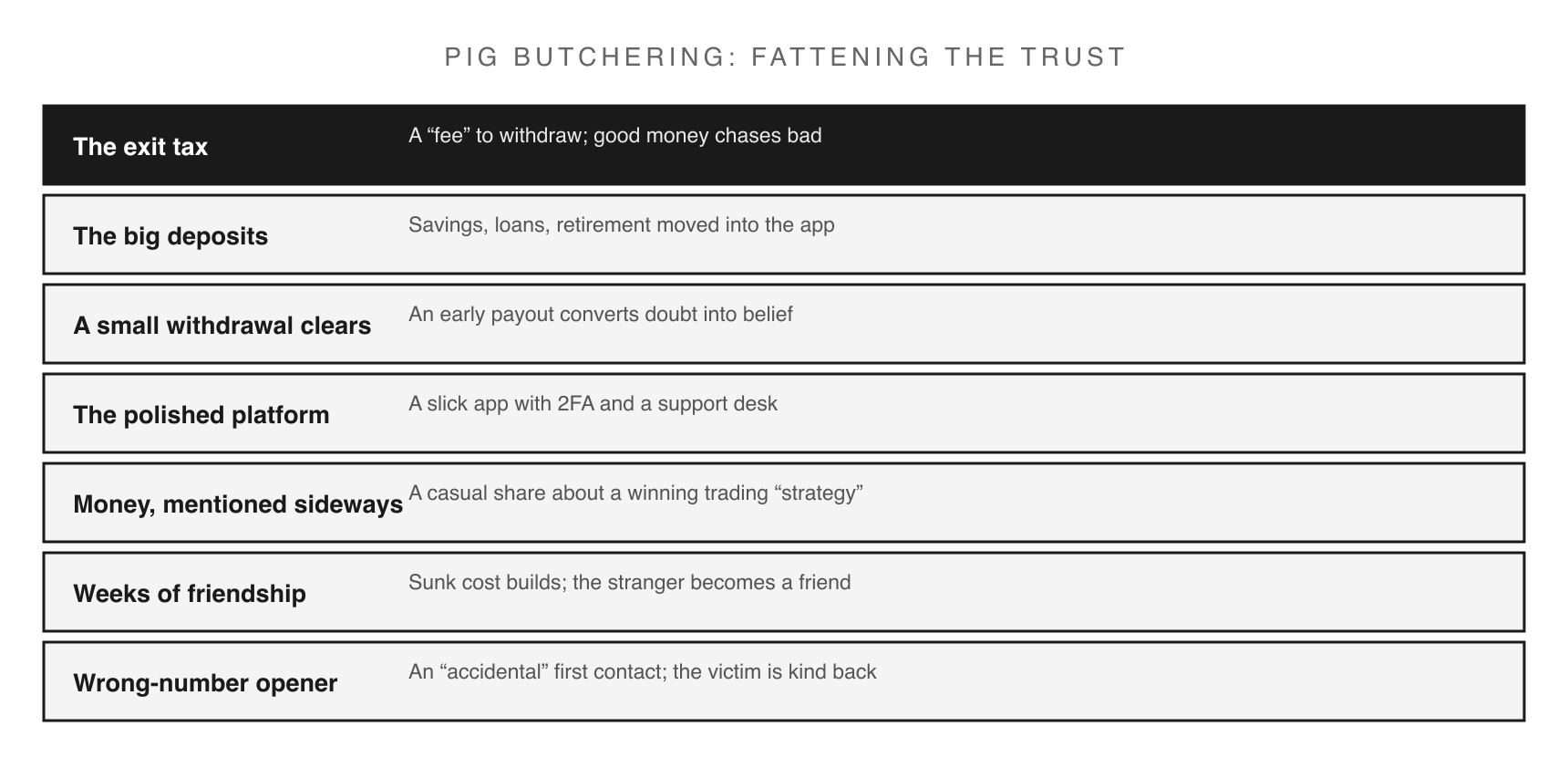
The numbers are no longer fringe. In 2025, the FBI's Internet Crime Complaint Center put cryptocurrency investment fraud — the category this scam dominates — at roughly $7.2 billion, part of $8.6 billion in investment-fraud losses overall. That figure is worth sitting with, because it dwarfs almost everything else in this book. The drive-by drainers, the malware-spam surges, the airdrop phishing — all of it, in aggregate, is a smaller line item than this one patient scam. Seven billion dollars, extracted not by breaking cryptography or compromising exchanges, but by talking to people. The exploit is the human relationship, and the relationship is the whole product.
The script is remarkably consistent, which tells you it is industrialized rather than improvised. It begins with a wrong number. A message arrives — on Telegram, on WhatsApp, increasingly as a "we matched" note from a dating app that pivots to a private channel — addressed to someone you are not. "Hi David, are we still on for lunch Thursday?" You reply, because you are a decent person, that they have the wrong number. The scammer apologizes, the conversation lingers, and a friendship begins. There is no pitch. That is the craft. For days or weeks there is no mention of money at all. There is a person — usually presented as successful, attractive, a little lonely, living a life adjacent to yours but more glamorous — who is simply interested in you. The accomplice in the early phase is loneliness, and the attacker is very good at finding it.
Shreya Datta's version began on Hinge. Datta — thirty-seven, a director at a multinational tech company in the Philadelphia suburbs, recently divorced — matched with "Ancel Mali," a French wine trader, charming, fit, attentive, who within days had moved the conversation to WhatsApp and deleted his dating profile, the better, he said, to focus on her. He video-called twice, briefly, pleading shyness. The photos, her family would learn much later, belonged to a German fitness influencer, and the brief calls had been faked; none of that was checkable in the moment, and the moment was pleasant. There was no pitch. For weeks there was simply a person — successful, a little lonely, living a life adjacent to hers but more glamorous — who was interested in her. Her case is documented in detail by The Philadelphia Inquirer and AFP, because Datta did the bravest thing a fraud victim can do and went on the record with all of it.
The money enters sideways. The new friend mentions, almost in passing, that an uncle or a mentor taught them a trading strategy. They are not selling it; they are just doing well, and they are happy. Eventually, because you asked, they show you the platform. The one Ancel showed Datta was a counterfeit of SoFi's trading app — polished dashboard, two-factor authentication, a customer-service desk that answered promptly and kept answering her for months. She started small: $1,000, which the dashboard grew to $1,250 within minutes. Then came the most important moment in the entire fraud: she withdrew it, all of it, successfully, into her own account. The pig has tasted the feed. The small withdrawal converts skepticism into belief — you do not have to believe the platform pays out, because you have seen it pay out, with your own money, into your own wallet. From the attacker's side, that early disbursement is the single most profitable few hundred dollars they will ever spend, because it buys five and six figures of belief. By late January, Datta had turned $6,000 into $9,000 on the screen. From there the deposits grow, the dashboard balance grows faster, and the withdrawals quietly stop working — a "tax" is owed, a "verification fee," a regulatory hold — until the day the channel goes silent and the app shows a balance you will never touch, because it was never anything but server-rendered numbers.
It is worth being precise about why each phase works, because the precision is what reveals the engineering underneath. The wrong-number and misdelivered-match openers work because they invert the burden of suspicion: a cold sales pitch puts you on guard, but a chance encounter makes you the one extending a small kindness, and a person doing a kindness is not in a defensive posture. The weeks of friendship before any mention of money work because they manufacture sunk cost in the relationship itself — by the time the trading platform appears, you are not evaluating a stranger's investment tip, you are taking advice from a friend, and the social cost of distrusting a friend is high enough that most people pay it rather than ask the rude question. Watch that cost get extracted from Datta directly: when she hesitated over liquidating her 401(k), Ancel needled her — "Can't you control your own money?" — and sent flowers on Valentine's Day; she cashed out the retirement account the next day. By the end of March she had moved $450,000 — savings, personal loans, retirement — into the counterfeit app. And the endgame ran exactly to script: when she finally tried to withdraw, the app demanded a 10 percent "personal tax" before her balance could be released. The tax works because it exploits the most human response to a near-loss, which is to throw good money after bad. You would be a fool to abandon $450,000 over a $45,000 fee — except the $450,000 was never there, and the tax is the only real number in the whole account. It took Datta's brother, a lawyer, and the private investigator he hired to tell her what she had been inside of. The shame, too, is part of the engineering; it is what keeps most victims silent, which is why a victim willing to put her name on the story is rare enough to be worth naming.
I want to flag that last detail, because it recurs across this whole class of fraud. The "platform" is not a trading venue. It is a front end with a fabricated backend — researchers who dissect these apps find polished branding wrapped around a remote server that renders whatever balance the operators choose, sometimes shipped through the official app stores with real listings and real reviews. The gains you watched accrue were a number in a database, set by the people robbing you. There was no trade. There was never a trade. The technique reaches its logical conclusion in the synthetic-community operations — the "Truman Show" fraud Check Point called OPCOPRO, which Chapter 11 dissects — where even the fellow investors cheering your gains are the attacker. For now, hold the structural fact: the screen lies, and the screen is the only evidence the victim ever has.
Now look at the other end of the conversation, because the cruelty there is layered on a cruelty that has nothing to do with technology at all. The early pig-butchering operations ran on human "keyboarders," and the keyboarders, in staggering numbers, are victims too. The UN's human rights office estimated in 2023 that at least 120,000 people were being held in scam compounds in Myanmar and roughly another 100,000 in Cambodia, most of them lured by fake job postings — customer service, translation, crypto trading — and then locked inside walled facilities in places like Myawaddy, on the Thai border, and Sihanoukville, on the Cambodian coast, their passports and phones confiscated on arrival. Survivor accounts collected by the UN, the BBC, and Deutsche Welle's investigation of the most notorious compound, Myanmar's KK Park, describe the same machinery from the inside: seventeen-hour shifts at the keyboards, daily quotas for money extracted, and a menu of punishments for missing them — fines, beatings, electric shocks, being "sold" to another compound with harsher conditions. One Thai survivor told UN investigators his quota ran to roughly $9,500 a day. The person typing sweet nothings to a lonely divorcee in Philadelphia is, in a horrifying share of cases, a trafficking victim typing for their own safety, juggling a dozen scripts under guard. The fraud has victims on both ends of the wire, and the people who profit from it never touch either one.
That human labor force was also, for years, the fraud's natural ceiling, and its cracks were the best detection signal defenders had. One keyboarder can only fatten so many pigs at once, and the keyboarder's own humanity leaked through: a worker juggling eight victims confuses their names, sends the wrong photo, replies at the wrong hour for the time zone they claim to live in, writes in a second language with tells a native speaker would notice. The fraud was profitable in spite of its labor, not because of it.
As we will see in the chapters on the AI inflection, that limit is gone, and with it the cracks. A language model never gets tired, never breaks character, never confuses David with Daniel, and can sustain a warm, attentive, individuated relationship with thousands of marks simultaneously, each in fluent idiomatic English or Mandarin or German, each with a consistent backstory the model never forgets because it is in the context window. The grammatical tells that once flagged a foreign-run scam compound are gone. The time-zone slips are gone, because the orchestration software sends at the right local hour. The patient con was already the most profitable scam in the catalog. Removing the labor ceiling — and, with it, every human imperfection that used to give the game away — is what turns it into a seven-billion-dollar industry. We will see in Part III an operation that did exactly this, running a fake-veteran community on jailbroken commercial AI; for now it is enough to know the labor problem that once capped this fraud has been solved by the attackers.
The compounds themselves finally drew blood-level enforcement in late 2025, and the arc is worth recording because of how it ends. On October 14, the US Department of Justice indicted Chen Zhi, chairman of Cambodia's Prince Group, over a network of forced-labor pig-butchering compounds, and moved to forfeit 127,271 bitcoin — roughly $15 billion, the largest forfeiture action in the department's history — while the US and UK sanctioned 146 associated people and entities. Six days later, the Myanmar military raided KK Park itself, releasing more than 2,000 workers; by December, 413 of its buildings had been demolished and SpaceX had cut off more than 2,500 Starlink terminals serving the compounds. It would be comforting to stop the story there. But AP and PBS reporting that followed the released workers found that many simply scattered to other compounds, and the operations re-formed around them. A compound, it turns out, is just a face the industry wears. Demolish one and the operation puts on another — a pattern that should feel familiar by now, and that the rest of this book will keep meeting at every scale.
There is one more reason this fraud belongs at the center of the book rather than the margins. Every defense we will examine later — keyword filters, behavioral heuristics, the shared banlists, the AI moderators — is built to detect messages that are bad. Pig butchering produces no bad messages. The conversation is friendly. The grammar is perfect. The links, when they finally come, point to apps with real App Store listings and valid TLS certificates. There is nothing in the content to flag, because the content is a relationship, and a relationship is not spam. The only thing wrong with the attacker is who they actually are — a stranger wearing a fabricated face, with no reputation you could have checked because no reputation system existed to check it against. That is the thread that runs under this entire book.
When the room is the weapon
Pig butchering targets the individual. The next family targets the crowd, and it does so by turning the crowd's own coordination into the attack. This is the coordinated pump-and-dump, and the crypto era did not invent it so much as remove every brake that had ever slowed it down.
The mechanics are old. You accumulate a thinly traded asset quietly, you generate a wave of buying that drives the price up, you sell into the hype you manufactured, and you leave the latecomers holding a collapsing bag. Securities regulators have chased this scheme in penny stocks for a century. What changed is that crypto markets run twenty-four hours a day with no listing requirements, no circuit breakers, and a long tail of low-liquidity tokens where a few hundred thousand dollars of coordinated buying can move the price hundreds of percent in minutes. And the coordination layer — the thing that historically took boiler rooms and cold-calling — is now a Telegram channel. If this seems like an odd neighbor for the long cons, notice what the operators spend their patience on: not any single mark, but the channel's manufactured track record, fattened call by winning call until it is credible enough to slaughter.
Solidus Labs, working with CoinDesk, documented one such ring in October 2025 that it tracked under the name PumpCell. The operation pulled in roughly $800,000 in a single month from coordinated pump-and-dump activity. What makes PumpCell instructive is not the size — it is on the small side for the categories in this chapter — but the structure, because the structure is the template for an entire cottage industry. There is a tiered membership. A small inner circle knows the target token and the timing in advance; they accumulate first. A larger paying membership receives the "signal" — the token, the entry, the call to buy — seconds or minutes later. And the broadest layer, the unwitting public who see the price ripping and pile in, are not members at all. They are the exit liquidity. By the time the signal reaches the public, the insiders are already selling into it.
This is a fraud built entirely out of timing and trust, and both are manufactured. The trust comes from the channel's reputation — a string of "winning calls," which are trivial to produce when you control the pump, plus screenshots of gains that may or may not be real, posted by accounts that may or may not be people. Consider how cheap the reputation is to fabricate. A channel that controls its own pumps can post a flawless track record because it is grading its own homework: it calls the token it is about to pump, the pump happens because the channel makes it happen, and the "10x in twenty minutes" screenshot is real in the narrow sense that the price did move — it just moved because the people posting the screenshot moved it. To a prospective subscriber scrolling the channel history, this is indistinguishable from genuine skill. There is no way to tell a trader who is good at finding momentum from an operator who manufactures the momentum they then "find." The reputation is real-looking and entirely hollow, and the subscription fee is the entry ticket to becoming someone else's exit.
The timing comes from execution tooling that the crypto era made available to everyone. The pumps in rings like this are not executed by hand. They run through sniper bots — Maestro and Banana Gun are the names that come up most often in these communities — that can place buys in the same block a token launches or a signal fires, sub-second, faster than any human and faster than the paying members they are nominally serving. The insiders' bots front-run their own subscribers. The subscribers' bots front-run the public. The fraud is recursive: every layer is exit liquidity for the layer above it, and the only people reliably making money are the operators who control both the signal and the fastest execution. The cruelest part is that the structure is self-justifying. When a subscriber gets a poor fill — buys at the top, sells into the dump — the channel does not have to explain itself, because "you were too slow" is a completely plausible story in a market where speed is everything. The fraud disguises itself as a meritocracy. You did not get scammed; you just need to upgrade to the faster tier, the closer-to-the-signal tier, the one that costs more. And so the victim's response to being defrauded is frequently to pay the fraudster more.
I single out the tooling because it foreshadows a theme the book returns to again and again: the same infrastructure that makes a market efficient makes the attack efficient. There is no malware here, no exploit, no stolen key — just a Telegram channel, a tiered subscription, a handful of trading bots, and a low-liquidity token. The whole apparatus is legal-adjacent enough that it advertises openly, and the victims pay for the privilege of being the bag.
And note what the defender is up against. There is no spam to filter — the channel is doing exactly what it advertises. There is no impersonation to detect — the operators use their own handles. The fraud is not in any single message; it is in the coordinated behavior of a population of accounts the platform has no way to tie back to the few humans actually pulling the strings. A defender inspecting content sees nothing wrong. A defender who could see identity would see one operator wearing the costume of an entire enthusiastic community. We are not there yet in the narrative, but the gap is already showing.
Targeting the people who should know better
There is a comforting story people tell themselves about scam victims, which is that the victims were naive. The next two families exist to demolish that story. They target the sophisticated — the founders, the fund managers, the experienced traders — and they succeed against them, because sophistication is not the same as Sybil-resistance, and the more money you move the more attractive a target you are.
Start with the fake-VC and over-the-counter outreach scam. Here the mark is a crypto founder or a token treasury, and the lure is the thing every founder wants: capital. The approach is professional from the first message. A representative of what appears to be a well-known venture fund or a reputable OTC trading desk reaches out — on Telegram, often after a warm-up on LinkedIn or X — expressing interest in an investment or a large block trade. The handles are right. The branding is right. The pitch deck they reference is real, because they pulled it from the fund's actual website. They know the founder's project in detail. The conversation moves with the cadence of real deal-flow, because the people running it have studied real deal-flow.
Coinpedia reported on one such operation in June 2025, attributed to an entity presenting itself as Aza Ventures, that extracted more than $50 million by posing as a Tier-1 VC and OTC counterparty. Fifty million dollars, taken not from retail investors clicking airdrop links but from the supposedly sophisticated end of the market — people whose entire job is evaluating counterparties. The fraud worked precisely because it inverted the victim's defenses. A founder who would never click a sketchy link will absolutely take a meeting with a fund that seems to want to give them money. The greed is not the mark's; it is harnessed as the mark's diligence. Wanting the deal to be real makes you sloppy about whether it is.
The "OTC" framing matters mechanically. Over-the-counter trades are bilateral and off-exchange by definition — that is the entire point of OTC. There is no order book, no central venue, no escrow you did not arrange yourself. So when the counterparty proposes the settlement mechanics — send the tokens here, the funds will release from there, sign this approval to "initialize" the trade — the founder is being walked, step by step, into authorizing a transfer or a token approval that drains the treasury. The sophistication of the target is exactly what the attacker exploits: a sophisticated person knows OTC settlement is supposed to look unusual, so unusual settlement instructions do not trip the alarm they should.
And underneath it all is the same rotten foundation. How does the founder know they are talking to the fund? Because the Telegram handle says so, and the avatar is the partner's headshot, and the bio links to the fund's domain. None of that is identity. Every piece of it is forgeable in minutes, and we will see in the next chapter exactly how cheaply. The fund's real partners have, somewhere, a verifiable existence — a track record, a reputation, credentials a counterparty could in principle check. But there is no path from a Telegram handle to that real-world reputation, no portable proof the founder could demand and verify, and so a fifty-million-dollar diligence process comes down to whether a username and a profile picture look right. They always look right. Looking right is free.
The natural defense a sophisticated founder reaches for is the one their instincts demand: get them on a call. A scammer can fake a handle, but surely not a face and a voice in real time. For a few years that instinct held. It does not anymore, and the people demonstrating that are the most professional adversaries in this entire book. The North Korean cluster that researchers track as BlueNoroff — part of the apparatus the U.S. government attributes to the DPRK's revenue operations — has built its recent crypto thefts precisely around defeating the "get on a call" reflex. The pattern that surfaced repeatedly through 2025 starts with a compromised real account. That is why the Thor theft from the prologue is worth dissecting here rather than retelling: every beat of it was an attack on a verification ritual. The approach arrived through a friend's real, hacked account, defeating do I know this person? The escalation to live video — the victim's own verification move, the thing a careful counterparty does — was the step the attacker had prepared for, and the faces on the call were synthetic. The check was the trap.
This is not a fringe technique. The DPRK's crypto-theft apparatus, whose roughly two-billion-dollar 2025 haul Chapter 11 takes up in full, has made the staged video meeting a production-line tool. Sit with what that means for the fake-VC fraud. The most sophisticated counterparty-verification a founder can perform — a live video call with a known contact — has been weaponized into the delivery mechanism for the fraud. The same collapse has hit voice: commercial voice-synthesis tooling can now clone a convincing voice from as little as three seconds of audio, by Trend Micro's April 2026 account of its researchers' testing, with fifteen to thirty seconds the older benchmark for a high-quality clone — material trivially harvested from a podcast appearance, a conference talk, a voice note. The same Trend Micro reporting, citing the FBI's 2025 internet-crime data, tied more than $5 million in 2025 losses to voice-clone distress and authorization scams — and that is the tracked subset of an impostor-scam total that runs far larger. The reason these belong in a chapter about high-value targets is that high-value targets are more exposed to voice and face cloning, not less, because they are public: the founder who has done podcast interviews and given conference keynotes has handed the attacker all the training data required to become them. Visibility, which is supposed to be reputation, becomes attack surface.
And notice that none of this changes the underlying problem — it deepens it. The deepfake call does not establish identity any more than the handle did; it forges a richer, more convincing appearance of identity. We have spent the entire history of online trust treating "looks like the right person" as a proxy for "is the right person," and the proxy is now fully and cheaply forgeable across every channel a human can perceive — text, brand, voice, face, and motion. There is no perceptual signal left to trust. The only thing that could have saved Thor's $1.35 million was not a better look at the face on the screen. It was a verifiable, cryptographic answer to the question is this account, this key, this counterparty actually who it claims to be — an answer the entire stack was, and largely still is, unable to provide.
Weaponizing the tools
The last family in this chapter is, in some ways, the darkest, because it attacks the most sophisticated users at their single point of maximum trust: the tools they use to trade.
The modern crypto trader does not place trades by hand. They use Telegram trading bots — Maestro, Banana Gun, and a wide ecosystem of others — that connect to a wallet and execute buys and sells through a chat interface, often inside the same trading communities where alpha is shared. The convenience is real and the adoption is enormous. It is also a security model that should keep you up at night, because the bot is, by design, holding the keys to or the signing authority over real funds, and it lives inside a chat application where anyone can message anyone and any link can be posted to any channel.
Crypto Times reported in May 2026 on a trader operating under the handle "Unihax0r" who lost more than $200,000 in a drain that hit across Ethereum, Base, and BSC — branded in the reporting around the name SIGMA. The cross-chain spread is the tell: this was not a single compromised contract but a compromise of the trader's access itself, propagating to wherever the trader held funds. And the vector in this class of attack is rarely a brilliant exploit. It is the fake-CAPTCHA and paste-and-run lure from the last chapter, deployed against the one population most thoroughly habituated to it. A trading channel is supposed to be full of bot prompts, verification gates, and links to new tools; a phishing prompt that would look alarming in your bank's app looks completely native here. Once the "verification" harvests a session token, the attacker holds the session, the session holds the bot, and the bot holds the funds. The fraud hides not in anomaly but in conformity — it looks like everything else in the room.
There is a second vector in this family, and one sentence will plant it, because the next chapter owns it: the trading-bot ecosystem runs on a supply chain of open-source packages, attackers have seeded the registries with poisoned look-alikes of the libraries this population pulls in without a second thought, and a trader who installs the wrong one hands over their keys before placing a single trade. These drains are not isolated cleverness. They ride on shared infrastructure, and someone is poisoning the infrastructure on purpose.
There is a deeper lesson in the SIGMA-style drains that connects the whole chapter. The trader who lost $200,000 was not naive. They were operating sophisticated tooling, in a community of peers, with funds spread across multiple chains in a way that suggests real competence. They were defeated not by a failure of knowledge but by a failure of verification — the inability, in the moment, to distinguish a legitimate prompt from a malicious one, a real peer from an attacker wearing the room's clothes, a genuine tool from a poisoned clone. Every fraud in this chapter reduces to that same failure. Not "the victim was stupid." The victim could not verify who or what they were dealing with, because the environment provides no way to verify anything, and the attacker's entire craft is to look exactly like the thing you would have trusted.
Why patient frauds are the hard problem
Step back and look at the four families together — the romance-investment con, the coordinated pump ring, the fake-VC outreach, the trading-bot drain. They target different people through different surfaces with different scripts, and yet they share a structure so precise it is almost a fingerprint.
First, they are economically rational at a level the smash-and-grab frauds are not. The drive-by drainer is a numbers game with a tiny conversion rate. These are different. A pig-butchering operator who invests three weeks of an AI's tireless attention to extract $80,000 is running a business with a margin that any legitimate enterprise would envy. The unit economics of patience are extraordinary once the labor cost collapses, which is exactly why the AI era — the subject of Part III — pours accelerant on this category specifically. The frauds that scale worst with automation are dying out. The frauds that scale best with automation are these, and that is not an accident; it is selection pressure.
Second, they are invisible to content-based defense. There is no keyword to filter in a friendly conversation, no malicious payload in a legitimate-looking app, no spammy phrasing in a professional VC pitch, no anomaly in a CAPTCHA prompt that lives in a channel full of CAPTCHA prompts. The thing that is wrong is never in the message. The defenses we have built — and the defenses we will spend the back half of this book examining — almost all inspect messages. These frauds route around message inspection entirely by producing messages that are, on their face, fine.
This is the point where it is worth pausing on the headline number again, because the $7.2 billion in 2025 crypto-investment-fraud losses is not just large — it is diagnostic. A fraud problem that could be solved by reading messages would not produce that figure, because we have spent two decades getting very good at reading messages. We can filter a Viagra ad in microseconds. We can fingerprint a phishing URL the moment it is registered. We can spot a wallet-drainer signature in a transaction before it confirms. The reason the patient frauds keep growing while the crude ones plateau is that the patient frauds attack the one layer our defenses never built: the question of who is on the other end. Every dollar of that $7.2 billion is a dollar that passed through a content filter, because there was nothing in the content to catch. The size of the number is a measurement of the size of the blind spot.
Third, and this is the thread the whole book is pulling, every one of these frauds is the same actor wearing a face it has no right to wear. The pig-butchering "friend" is a fabricated person. The pump ring is one operator in the costume of an enthusiastic crowd. The fake VC is a stranger wearing a real fund's brand. The drainer is an attacker wearing the trading room's native uniform. In every case the attack succeeds because the victim extends trust to an identity, and the identity is free to fabricate, free to multiply, and impossible to verify against any durable reputation. And none of it — the counterfeit trading app, the tiered pump franchise, the drain kit, the account farms supplying the faces — is the work of a clever individual improvising between victims. Each piece is a product, with a vendor, a price, and a support channel of its own, sold to a thousand operators who never met each other and never will. To understand why every defense in the back half of this book keeps losing, you have to stop thinking about scammers and start thinking about the economy that equips them. That economy is the subject of the next chapter, and it is more organized than most of the companies trying to stop it.
These were not lone scammers. Behind them was an industry.